






Skip to content

    Modernize your eCommerce storefront,
    without replacing the platform

    A faster, more flexible customer experience without a big-bang commerce migration

    Does this sound familiar?

    Releases take too long

    New features wait for commerce platform release cycles.

    Mobile experience is costing conversion

    Slow pages and an outdated mobile experience make buying harder.

    Campaigns depend on developers

    Content changes and new ideas end up in the development backlog.

    Accessibility is difficult to improve

    The current frontend makes improvements slow and expensive.

    The commerce platform itself still works

    There is no business case for replacing everything.

    Modernize the experience,
    not everything at once

    Improve what customers see first, while keeping the systems that still provide value.

    Today

    Platform-bound storefront
    ↓
    Commerce platform
    ↓
    CMS  ·  Search  ·  PIM  ·  ERP  ·  Integrations

    Changes to the customer experience are tied to the commerce platform and its release cycle.

    Modernized

    Solteq Next.js Storefront
    ↓
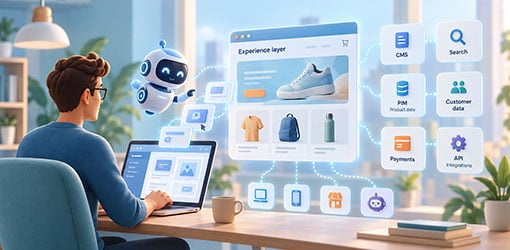
    Capability layer
    ↓
    Existing commerce platform
    ↓
    CMS  ·  Search  ·  PIM  ·  ERP  ·  Integrations

    The storefront evolves independently, while the existing backend ecosystem stays in place.

    What changes for the business

    A modern storefront helps you improve customer experience, performance and development speed — continuously.

    Better customer experience

    Modern UX and UI, mobile-first design and accessibility built in from the start.


    Better performance

    Faster pages, server-side rendering and caching for better Core Web Vitals and SEO.

    Faster development

    AI-assisted development from Figma to Storybook to code, with a shorter path to production.


    Continuous improvement

    Analytics-led optimization and A/B testing as part of normal development.

    eCommerce team testing a storefront across desktop, laptop and mobile devices.

    Proven in a real storefront POC

    Delivered ahead of a one-month commitment

    For a large Finnish omnichannel retailer with an extensive product catalogue and an existing API-based commerce backend, Solteq built a working storefront POC covering the key customer journey and integrated it with the retailer’s existing commerce, CMS and search services.


    5× faster mobile page load

    Time until the main image or text block appears.


    13× more traffic per server

    57 vs 4.2 page views per second.


    3–5× fewer backend calls

    Around 7 vs 20–35 calls per page view.


    3× higher front-page Lighthouse score

    Measured in a mobile Lighthouse test.


    Lab tests, Aug–Sep 2026. Mobile load time based on Lighthouse LCP, median of 26 pages. Capacity tested on same-size servers with cached pages. The current webshop was behind a CDN; the POC was not.

    Start small. Prove the value. Move to production.

    Modernize one step at a time, from a short discovery to a production-ready storefront.

    01
    →

    Discovery

    Review the current storefront, its constraints and the most valuable modernization opportunities.

    02
    →

    POC on your data

    Build a working storefront POC using your own catalogue, APIs and test environment.

    03
    →

    Joint validation

    Review the customer experience, performance and delivery model together.

    04
    →

    Storefront migration

    Turn the validated POC into a production-ready storefront and migrate the required customer journeys.

    05

    Go live

    Launch the new storefront and gracefully retire the legacy frontend.

    And you can stop there.

    Further commerce capabilities can be renewed independently later, when there is a clear business reason to do so.

    AI-assisted development is changing the build vs. buy equation for custom storefronts. What used to require significantly more manual development can now be built and evolved faster with reusable components, established integration patterns and a more streamlined path from design to implementation.

    That also changes how commerce modernization can be approached. Instead of replacing the entire stack at once, the customer experience can be decoupled first while the existing commerce engine, CMS, search and other systems remain in place, and renewed later only when there is a clear business need.

    Read the article →

    Ulla Kauppila

    Discuss your storefront

    Ulla Kauppila

    Sales Director, Commerce & Data

    +358 44 970 6013